
The Fragile Peace in Tigray: A Region on the Brink
Tensions Rise in Tigray as Internal Power Struggles and External Pressures Threaten Fragile Peace

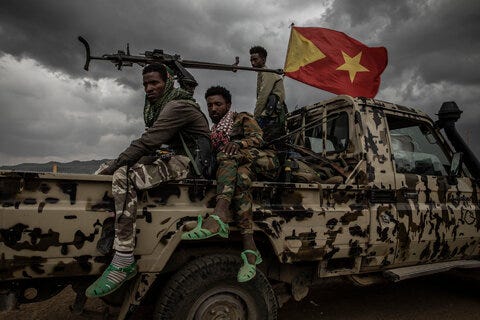
More than two years have passed since the signing of the Pretoria Agreement (Cessation of Hostilities Agreement ‘CoHA’) in November 2022, which sought to bring an end to one of the deadliest conflicts of the 21st century in Ethiopia’s Tigray region. The war between the Ethiopian federal government and the Tigray People’s Liberation Front (TPLF) claimed an estimated 300-800,000 lives, displaced millions, and left a scarred landscape of trauma and destruction (according to a study by the BMJ). Yet, despite the ceasefire, Tigray stands once again on the precipice of renewed violence with the "two countries [Ethiopia and Eritrea] inching closer to a new war". Internal divisions, external pressures, and unresolved grievances threaten to unravel the fragile peace, with potentially catastrophic consequences for the region and the broader Horn of Africa.
A coalition of Western embassies, including those of the United States, Britain, Japan, and the European Union, released a joint statement emphasising that "there must be no return to violence."
In a post on the UK embassy's X account, they stated, "We strongly urge all parties to safeguard the (2022) Agreement by reducing tensions and engaging in immediate dialogue."
Earlier, France advised its citizens in Tigray to "prepare by stockpiling emergency supplies such as food, water, medicine, and possibly fuel, while exercising extreme caution."
The current crisis stems from a power struggle within the TPLF, the political force that has dominated Tigray for decades. The party has fractured into rival factions, pitting the interim regional president, Getachew Reda, against the TPLF’s longtime leader, Debretsion Gebremichael. This rift has escalated beyond political rhetoric into military posturing. In mid-March, forces loyal to Debretsion seized control of Adigrat, Tigray’s second-largest city, while Getachew accused his rivals of orchestrating a coup with external backing. Residents report an atmosphere of fear, with bank runs and sold-out flights signaling a population bracing for the worst.
This internal discord is compounded by the specter of external involvement. Eritrea, a historic adversary of the TPLF, looms large in the narrative. During the 2020-2022 war, Eritrean forces fought alongside Ethiopian troops, leaving a legacy of alleged atrocities and a deep-seated enmity with Tigrayan leaders. Despite the Pretoria Agreement’s call for the withdrawal of foreign forces, reports persist of Eritrean troops lingering in parts of Tigray. Getachew has pointed fingers at Asmara, alleging collusion with Debretsion’s faction—a charge denied by both Eritrea and Debretsion’s allies. Meanwhile, Ethiopia’s federal government, under Prime Minister Abiy Ahmed, faces its own tensions with Eritrea over maritime access, adding another layer of volatility to the mix.
The stakes could not be higher. Tigray remains a humanitarian disaster zone, with 15 percent of its 7 million residents still displaced and basic services in tatters. The Pretoria Agreement’s promises—disarmament of Tigrayan fighters, the return of displaced people, and the restoration of stability—have largely gone unfulfilled. A return to conflict would not only deepen this suffering but could also destabilize the Horn of Africa, a region already grappling with wars in Sudan and Somalia. Eritrea’s potential intervention, coupled with Ethiopia’s deployment of troops near the border, raises the chilling prospect of a broader regional war.
Yet, the seeds of this crisis were sown long before the current factional strife. The 2022 peace deal, while a diplomatic achievement, sidelined critical issues. Western Tigray, a fertile and resource-rich area seized by Amhara forces during the war, remains a flashpoint, with Tigrayan leaders vowing to reclaim it. The failure to address this territorial dispute has fuelled resentment and mistrust. Likewise, the exclusion of Eritrea from the Pretoria talks left a key player dissatisfied, potentially incentivising Asmara to exploit Tigray’s divisions to weaken both the TPLF and Ethiopia.
However, in an unprecedented move, eight survivors of the Tigray conflict have taken a crucial step towards justice by filing the first-ever criminal complaint with the German Federal Public Prosecutor against high-ranking Ethiopian and Eritrean officials. This historic complaint represents a beacon of hope for the countless victims who continue to suffer the consequences of one of the most harrowing humanitarian crises in recent history.
The Tigray conflict, largely overshadowed in global discourse, is marked by allegations of egregious war crimes and human rights abuses. Since its inception in November 2020, a dark narrative of starvation, sexual violence, and massacres has unfolded, claiming many lives. The scars of the conflict run deep, and the survivors, who are now demanding accountability, have borne witness to despair and immeasurable loss.
These survivors, along with their legal representatives, are urging Germany to leverage the principle of universal jurisdiction to initiate investigations into crimes committed abroad. This principle has been effectively utilized by German courts to address atrocities in Syria, The Gambia, and Iraq. The case of the Tigray conflict is now poised to test the willingness of international judicial systems to provide recourse to those silenced by borders.
Tsega, a courageous survivor whose identity is shielded for protection, encapsulates the collective yearning for justice. Having lost immediate family to the cruelty of war, Tsega underscores the necessity of accountability as a pathway to peace for Tigrayans, who continue to endure the conflict's lingering impact.
The involvement of Legal Action Worldwide, alongside partners like Debevoise & Plimpton LLP and the European Center for Constitutional and Human Rights, bolsters this judicial endeavor. Their collaborative efforts underscore a collective demand for transparency and justice—one that reverberates beyond Tigray to safeguard fundamental human rights globally.
The German filing follows a series of legal maneuvers, including a prior submission to the African Commission on Human and Peoples’ Rights, showcasing a strategy to hold perpetrators accountable across multiple jurisdictions. This continual push for justice reflects both the resilience of survivors and the enduring will of international legal bodies to address grave breaches of human rights.
Antonia Mulvey, Catherine Amirfar, Dr. Anna Oehmichen, and Andreas Schüller are among the voices amplifying this call for justice, emphasizing that the mere acknowledgment of these crimes is insufficient; action is imperative. Their statements resonate with the hope that the German Federal Public Prosecutor will prioritize these proceedings, thereby fulfilling its role as a key player in the international criminal justice ecosystem.
This op-ed stands as a reminder of the unyielding pursuit of justice—a pursuit emboldened by the voices of those who survived the unspeakable, and empowered by the legal mechanisms available to confront tyranny and restore dignity. As the world watches, the unfolding of this unprecedented case holds the potential not only to bring justice to Tigray but to reinforce the universal commitment to human rights and accountability.
International attention, however, has been fleeting. The war in Ukraine and other global crises have overshadowed Tigray’s plight, despite its staggering human toll. This neglect must end. The United Nations, African Union, and Western powers—particularly the United States and United Kingdom—have a moral and strategic imperative to act. Mediation between the TPLF factions is essential, as is pressure on Ethiopia and Eritrea to de-escalate. A truly inclusive administration in Tigray, one that bridges the divide between Getachew and Debretsion, could restore legitimacy and calm tensions. Moreover, the international community must enforce the Pretoria Agreement’s terms, ensuring the withdrawal of foreign forces and the return of displaced populations.
Skeptics might argue that Eritrea’s restraint thus far suggests a reluctance to engage, or that Ethiopia’s federal government has little appetite for another war. But history teaches us that brinkmanship can spiral unpredictably. The speed of military mobilization—by the Ethiopian army, Eritrean forces, and Tigrayan factions—echoes the prelude to the 2020 conflict. Confidence in military superiority, coupled with a lack of diplomatic off-ramps, risks tipping the region into chaos once more.
Tigrayans, weary from years of bloodshed, deserve better than another war. The international community must heed their pleas—voiced on platforms like X, where calls for justice and intervention proliferate—before it’s too late. A renewed conflict would not only shatter Tigray but could ignite a fire across the Horn of Africa, with repercussions felt far beyond its borders. The time to act is now, lest we witness yet another chapter of preventable tragedy unfold.